Your website still works.
People can open it.
Your contact page is there.
So why would you redesign it?
Because a website can technically work while still hurting your business.
It may look outdated. It may be difficult to use on mobile. It may load slowly. Visitors may struggle to understand your services. Or you may be getting traffic but very few inquiries.
That does not always mean you need to rebuild everything.
But there are some clear signs that your website needs attention.
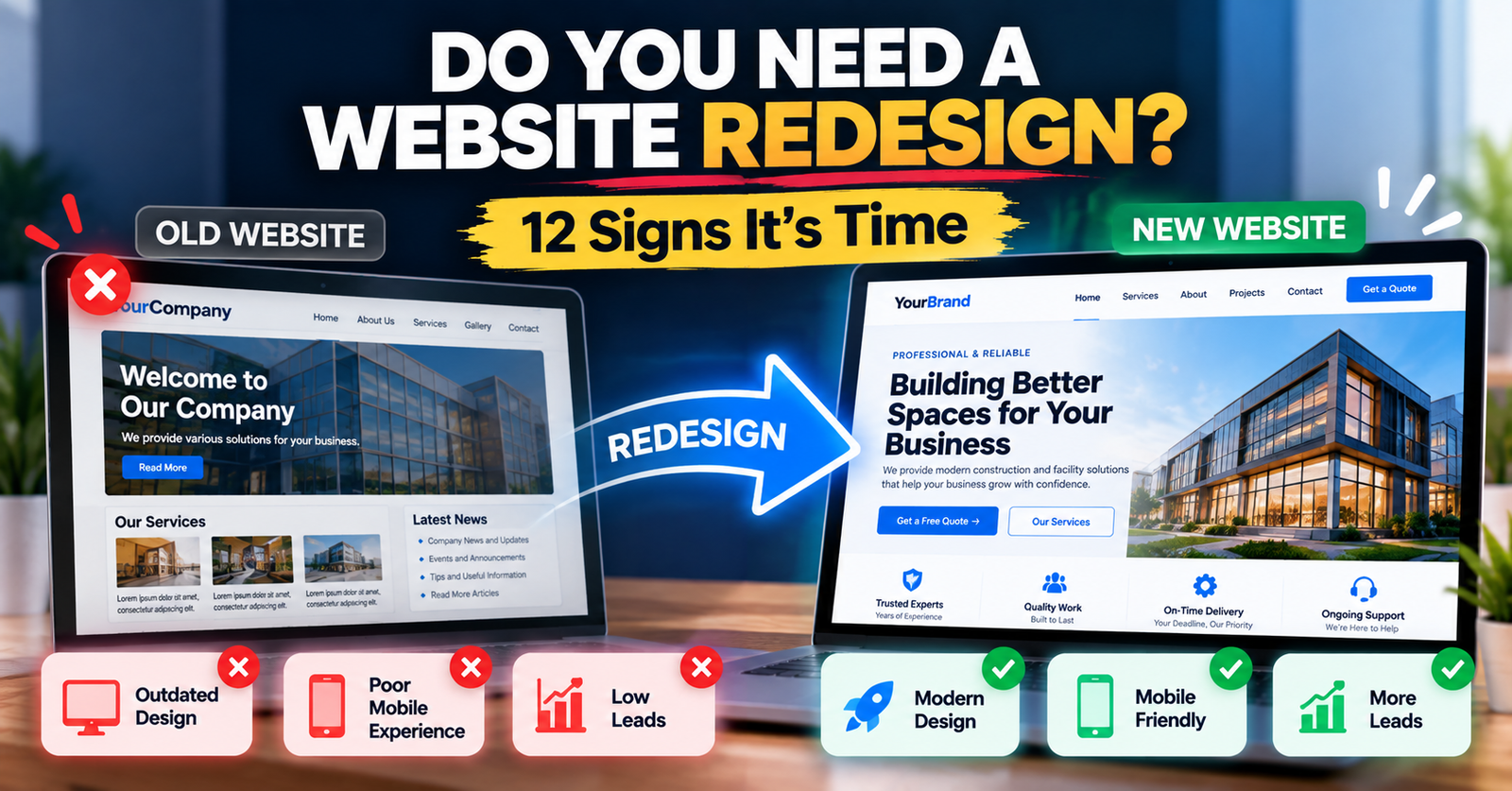
Here are 12 signs it may be time to redesign your business website.
- Your Website Looks Outdated
This is one of the easiest problems to notice.
Web design changes over time.
A website built several years ago may still function, but it can feel old compared with modern websites in your industry.
Common signs include:
Old-looking fonts
Very small text
Outdated buttons
Heavy gradients
Too many different colors
Crowded layouts
Small images
Old stock photos
Large blocks of text
Poor spacing
Your website does not need to follow every design trend.
But it should feel professional and current.
Visitors often form an impression of a business very quickly.
If your website looks neglected, some visitors may assume the business is neglected too.
- Your Website Does Not Look Good on Mobile
Open your website on your phone.
Do not only resize your desktop browser.
Use a real mobile device.
Can you easily read everything?
Can you tap the buttons?
Does the menu work properly?
Can you complete the contact form without zooming?
Look for problems such as:
Text that is too small
Buttons too close together
Images going outside the screen
Horizontal scrolling
Broken sections
Huge empty spaces
Forms that are difficult to complete
Popups covering the screen
If mobile visitors have a poor experience, redesigning or rebuilding important sections may be necessary.
- Your Website Is Slow
A beautiful website is not very useful if visitors have to wait too long for it to load.
Website speed can be affected by:
Large images
Poor hosting
Too many plugins
Heavy scripts
Background videos
Complex animations
Third-party widgets
Poorly built pages
Sometimes you can fix performance without redesigning the website.
But older websites often have several performance problems at the same time.
In that case, rebuilding heavy pages with a cleaner structure may make more sense.
- Visitors Cannot Quickly Understand What You Do
Imagine someone visits your homepage for the first time.
Within a few seconds, can they understand:
What do you do?
Who do you help?
Where do you work?
What should they do next?
If the answer is no, your website has a messaging problem.
For example:
“Welcome to ABC Solutions”
does not tell a new visitor very much.
Something like:
“Commercial Roofing Services for Businesses in Dallas, TX”
is much clearer.
Good website design is not only about colors and images.
The design should help communicate your message.
- Your Website Is Getting Traffic but Not Leads
You may already have visitors coming from:
Social media
Ads
Referrals
Direct traffic
But very few people contact you.
This can happen when the website does not guide visitors toward the next step.
Possible problems include:
Weak calls-to-action
Confusing navigation
Poor service pages
Long forms
Lack of trust
Unclear offers
Poor mobile experience
Important information being difficult to find
A redesign should not only make the website prettier.
It should improve the path from visitor → interested prospect → lead.
- Your Website Has No Clear Call-to-Action
Every business website should have a clear next step.
Depending on the business, this could be:
Get a Quote
Book a Consultation
Schedule an Appointment
Call Now
Request an Estimate
Contact Us
Get Started
If your website has no obvious CTA, visitors may browse and leave.
The opposite can also be a problem.
If every section has five different buttons, visitors may not know which action matters most.
A redesign can create a clearer conversion path.
Choose a primary action and make it easy to find.
- Your Navigation Is Confusing
Your menu should help people find information.
It should not make them think too hard.
Problems can appear when a website has:
Too many menu items
Confusing page names
Several levels of dropdowns
Broken links
Duplicate pages
Important pages hidden deep inside the website
A visitor looking for a service should not have to click through several unrelated pages.
Keep navigation simple and logical.
For many business websites, visitors mainly need quick access to your services, about information, service areas, contact information, and other important pages.
- Your Website No Longer Matches Your Business
Businesses change.
Maybe you started with three services and now offer ten.
Maybe you changed your target market.
Maybe you serve new locations.
Maybe your branding changed.
Maybe you now focus on a completely different type of customer.
But your website still represents the old version of your business.
That creates a disconnect.
Your website should reflect what your business is today, not what it was several years ago.
Review your:
Services
Branding
Photos
Team information
Service areas
Contact information
Offers
Positioning
Calls-to-action
If a large part of the information is outdated, a redesign may be more efficient than making dozens of small changes.
- Updating Your Website Is Difficult
A business owner should not be afraid to update basic website content.
If changing a phone number, photo, service, or paragraph requires a developer every time, your website may be unnecessarily difficult to manage.
Older websites can contain:
Hard-coded content
Old page builders
Unsupported themes
Custom systems nobody understands
Shortcodes from deleted plugins
This can make even simple changes risky.
A redesign can give you a cleaner system that is easier to maintain.
For WordPress websites, tools such as Elementor can make content management easier when the website is built properly.
- Your Website Has Broken Pages or Features
Small problems can build up over time.
You may notice:
Broken links
Missing images
Forms that do not work
Layout problems
Buttons going nowhere
Console errors
Broken sliders
Old integrations
404 pages
Mobile display problems
One broken link does not mean you need a complete redesign.
But if problems appear throughout an old website, rebuilding parts of the site may be more practical than repeatedly fixing individual issues.
- Your Website Does Not Build Enough Trust
Before contacting you, potential customers want to feel comfortable with your business.
Your website can help build that trust.
Depending on your industry, useful trust elements can include:
Customer reviews
Testimonials
Real project photos
Case studies
Team photos
Certifications
Guarantees
Years of experience
Business address
Service areas
Clear contact details
An old website may hide these elements or not include them at all.
A redesign gives you an opportunity to make trust part of the website structure rather than adding testimonials as an afterthought.
- Your Competitors Have a Much Better Online Experience
Do not redesign your website just because a competitor changed their colors.
But you should understand what customers see when comparing businesses.
Visit several competitor websites.
Look at:
How clearly they explain services
Mobile usability
Page speed
Calls-to-action
Reviews
Project examples
Booking or quote process
Service pages
Overall ease of use
The goal is not to copy competitors.
The goal is to understand what customers in your market may expect from a modern website.
If your website makes basic tasks much harder than competing websites, it may be time to improve it.
Do You Need a Full Website Redesign?
Not always.
This is important.
You should not rebuild a website simply because it is a few years old.
Sometimes the existing website has a good foundation.
You may only need to improve:
Homepage
Hero section
Navigation
Mobile layout
Calls-to-action
Contact forms
Service pages
Images
Website speed
SEO structure
A partial redesign can sometimes solve the problem for less time and money.
The decision should depend on what is actually wrong with the website.
When Does a Full Redesign Make More Sense?
A larger redesign may make sense when several problems exist at the same time.
For example:
Your website looks outdated.
It is difficult to use on mobile.
The pages are slow.
The navigation is confusing.
Your services have changed.
The website is difficult to update.
And you are getting very few leads.
At that point, fixing each problem separately may create more work than rebuilding the important parts with a better structure.
What Should a Website Redesign Improve?
A redesign should have a purpose.
Before starting, decide what needs to improve.
For a service business, common goals include:
More leads
Make it easier for visitors to call, request a quote, or book an appointment.
Better mobile experience
Make important pages easy to use on phones.
Faster loading
Reduce unnecessary weight and optimize important pages.
Clearer services
Help visitors quickly understand what you offer.
More trust
Show reviews, projects, experience, and other proof.
Better SEO structure
Organize pages and content so search engines and users can understand them.
Easier management
Make future content changes simpler.
Without clear goals, a redesign can become nothing more than changing colors and images.
Website Redesign vs Website Refresh
These are not always the same thing.
A website refresh usually involves smaller visual or content improvements.
For example:
New colors
Better typography
Updated images
Improved spacing
New CTA buttons
A website redesign usually involves larger changes to the website experience.
This may include:
New page layouts
Navigation changes
New content structure
Mobile improvements
Conversion improvements
New service pages
Performance improvements
Technical changes
Which one you need depends on the current condition of your website.
Before Redesigning Your Website, Check Your Data
Do not throw away useful parts of your existing website without checking what already works.
Before making major changes, review your analytics and search data.
Look for:
Pages receiving organic traffic
Pages generating leads
High-performing blog posts
Important landing pages
Search queries
Existing backlinks
Popular services
If a page performs well, you may want to improve it rather than completely replacing it.
Also be careful when changing URLs.
Changing or deleting important URLs without a proper plan can create SEO problems.
A Simple Website Redesign Checklist
Before deciding, ask yourself:
Does my website look professional?
Does it work properly on mobile?
Is it reasonably fast?
Can visitors understand my business quickly?
Are my services easy to find?
Do I have clear CTAs?
Are my forms working?
Does the website build trust?
Is the content current?
Can I easily update the site?
Am I getting useful leads?
Does the website support my current business goals?
If you answer no to several of these questions, your website probably needs improvement.
Whether that means a few targeted fixes or a full redesign depends on how serious the problems are.
Need Help Redesigning Your Website?
A website redesign should do more than make your website look modern.
It should make your website easier to use, easier to understand, faster, and better at turning visitors into potential customers.
I help businesses design, redesign, and improve WordPress, Elementor, and Shopify websites.
I can help with:
Website redesign
WordPress and Elementor design
Shopify website improvements
Mobile responsive fixes
Conversion-focused layouts
Website speed improvements
Landing pages
Website fixes
Basic SEO improvements
If you are not sure whether you need a complete redesign or just a few improvements, I can review your existing website first.
Want to improve your website? Contact me and share your website URL.